When choosing armor, it’s not the logo that matters, but what it’s made of. The materials determine whether the plate will stop a bullet, how it behaves under repeated hits, and how much weight it adds to your gear. Below is a concise and honest breakdown of the main materials used in today’s ballistic plates.
Aramid fibers (Kevlar, Twaron) - proven classics
Aramid is a synthetic fiber with extremely high tensile strength. It has been used for decades in soft armor panels and as a reinforcing layer in hard plates. Its strengths include excellent energy absorption from fragments and small-caliber rounds, shape stability, and predictable performance. The downside is weight: for the same protection level, aramid solutions are heavier than modern polyethylene-based materials.
In practice: for protection against handgun threats and fragmentation, aramid is a reliable choice. When armor-piercing rounds are expected, it’s often combined with a ceramic strike-face.
UHMWPE - minimal weight, maximum performance
UHMWPE (ultra-high molecular weight polyethylene) is the material that made armor lighter without compromising protection. It is resistant to moisture, doesn’t corrode, and handles multiple hits well, saving hundreds of grams on a soldier’s load. The limitation is sensitivity to heat: plates should not be exposed to high temperatures or stored near heat sources.
Best suited for: operators who move a lot, work in mobile units, and wear their gear for extended periods. Where every gram matters, UHMWPE makes a noticeable difference.
Ceramics (Al₂O₃, SiC, B₄C) - the strike layer against armor-piercing threats
The ceramic strike-face is the first to meet the bullet and literally breaks its trajectory: the projectile’s jacket shatters, energy is dissipated, and the UHMWPE or aramid backing absorbs the remaining impact. The choice of ceramic determines the balance between price, weight, and protection level:
• Al₂O₃ (aluminum oxide) - affordable and durable, but heavier;
• SiC (silicon carbide) - lighter and more expensive, a good compromise;
• B₄C (boron carbide) - the hardest and lightest of the three, but also the most costly.
It’s important not only what type of ceramic is used, but also how it’s bonded: the adhesion quality between layers and the proper backing determine performance in multi-hit tests.
Hybrid constructions - lighter yet stronger
Modern ballistic plates are not made from a single material but from a layered composite: a ceramic front + a polyethylene or aramid backing. The hybrid structure achieves balance - effective protection against armor-piercing threats at a reasonable weight. In real field conditions, such combinations often “survive” longer than single-material solutions.
Stand-Alone vs ICW - which type to choose
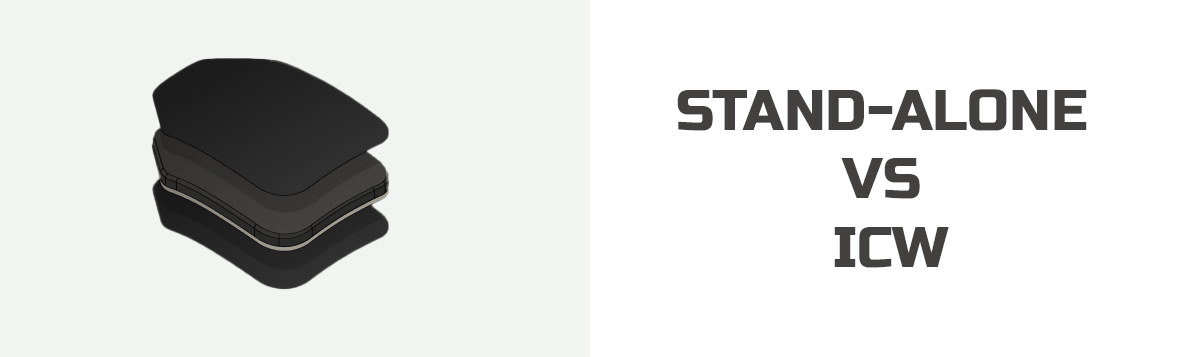
One of the key distinctions in ballistic plates is between ICW (In Conjunction With) and Stand-Alone (SA). An ICW plate is designed to work together with a soft armor panel - by itself, it does not provide the full protection level, but within the “plate + soft” system, it offers a balanced combination of protection and mobility. A Stand-Alone plate, on the other hand, is self-sufficient: it includes all necessary layers and materials to achieve the rated protection without additional backing. Such a plate can withstand impacts even without a soft insert, but it’s typicall